
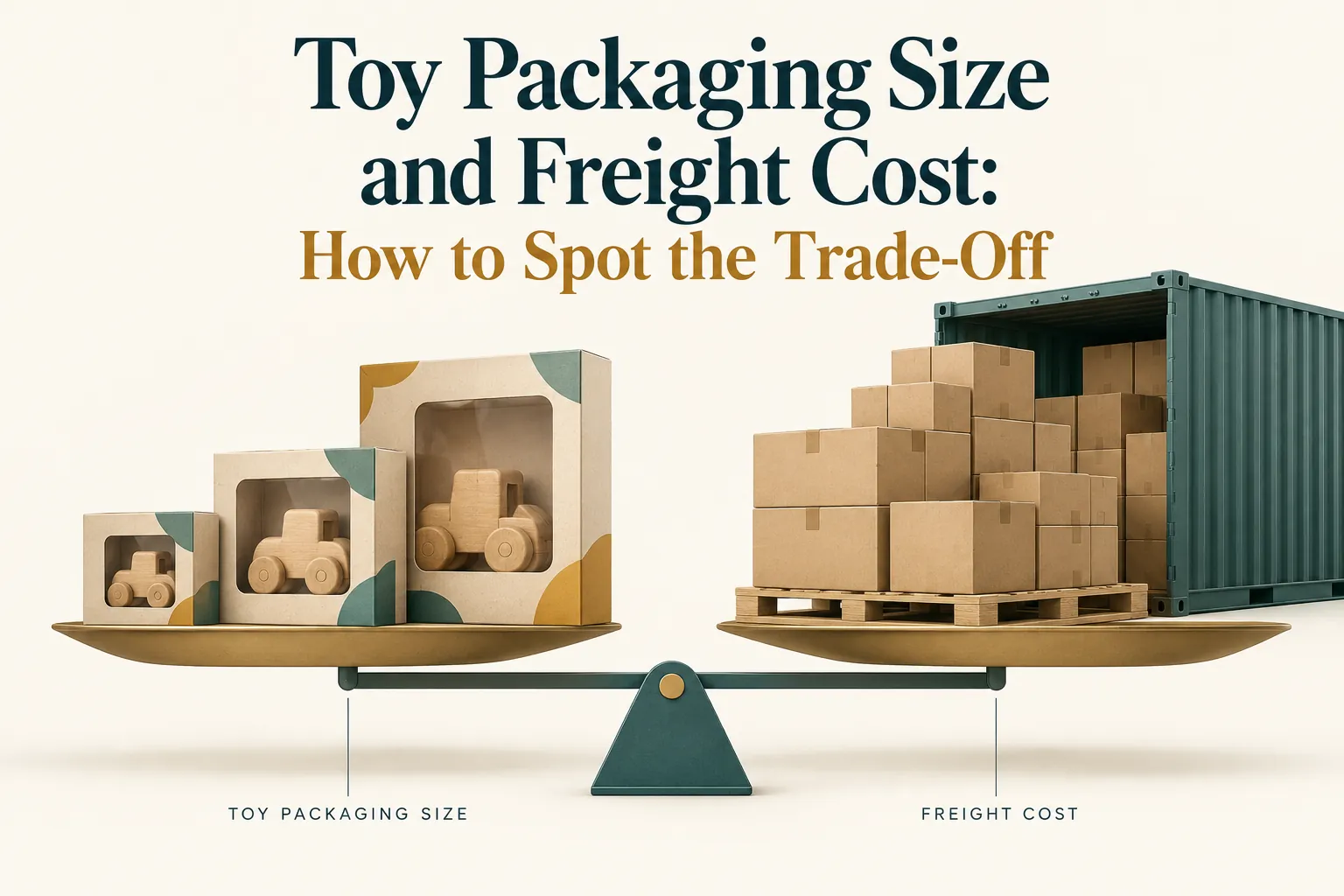
Choose the smallest toy packaging that preserves agreed protection and retail presentation, then compare freight per saleable unit—not box size or toy price alone. Toy packaging size and freight cost trade off through outer-carton CBM, units per carton and the carrier’s charging basis. Keep a larger display box only when its specific merchandising function justifies the additional landed cost; approve a smaller format only after checking product restraint, carton strength and the finished shelf presentation.
A bulky finished package can make an inexpensive toy costly to ship. The carton-planning guide published June 14, 2026, identifies boxed electronic toys, counter displays and gift sets as configurations where buyers should compare the packed product and shipment assumptions rather than unit price alone. Carton planning guide
Which fields make toy packaging options comparable?
Use one comparison record for each product and packaging revision, separating the agreed specification from measurements and inspection observations.
Carton quantity, dimensions and weight belong to the specific packing configuration; do not copy them from another product or an earlier box design. This is also the planning approach stated in the June 14, 2026 carton guide. Carton planning guide
| Product, packaging revision and evidence date | Identify the product reference, retail-pack format, insert revision and master-carton revision. Attach the dated supplier specification, measured packing sheet or sample inspection record supporting each entry. |
|---|---|
| Carton specification: target versus observation | Record agreed units per inner pack and master carton, external length × width × height with units, and packed gross weight. Put measured results beside those targets; distinguish external shipping dimensions from internal fit dimensions. |
| CBM and freight basis | Calculate carton CBM from measured external dimensions, then calculate CBM per saleable unit and total shipment CBM. Attach a dated freight quote identifying route, service, charging basis, included charges and treatment of pallets or other shipping packaging. |
| Damage-risk comparison | Specify the protection target and record actual findings: product movement, contact between components, insert displacement, carton deformation and retail-box scuffing. Identify the sample revision, inspection method and date. Treat these as purchasing observations, not a predicted damage rate. |
| Display-value comparison | State the intended selling format and assess the finished sample against it: shelf fit, facing width, readable graphics, product identification and setup requirements. Record the reviewer and date rather than assigning an unsupported sales uplift. |
| Decision and closure | Record approve, revise or hold; any conditions; the responsible approver and decision date; and the owner and closure date for follow-up checks. Keep the approved sample and packing revision linked to the order. |
What do two color-box toy records tell a buyer?
The outdoor vest-and-ball chase game lists 16 units per carton, while the electric foam-dart blaster lists 24; the higher count is not, by itself, evidence of lower freight per toy.
These are separate product lines, not tested alternative packages for the same toy. The catalog facts below come from the October 9, 2026 snapshot, source asset 9837. Protection and display checks are proposed buyer criteria, not reported inspection results.
| Outdoor vest-and-ball chase game — CHT-305370 | Recorded packing: color box. Recorded carton quantity: 16 units. Carton specification to confirm: final external dimensions, packed gross weight and packing revision. CBM comparison: measured master-carton CBM ÷ 16 gives CBM per unit. Proposed damage-risk checks: confirm that the vest and balls remain contained and do not distort the retail box. Proposed display-value check: assess whether the finished color box clearly communicates the set contents within the intended shelf space. Catalog source/date: asset 9837, October 9, 2026. |
|---|---|
| Electric foam-dart blaster — CHT-338783 | Recorded packing: color box. Recorded carton quantity: 24 units. Carton specification to confirm: final external dimensions, packed gross weight and packing revision. CBM comparison: measured master-carton CBM ÷ 24 gives CBM per unit. Proposed damage-risk checks: inspect restraint of the blaster and darts, component contact and retail-box deformation. Proposed display-value check: assess product identification, graphics readability and shelf fit on the finished box. Catalog source/date: asset 9837, October 9, 2026. |
How can you compare CBM without confusing carton count with efficiency?
Compare carton CBM divided by the number of saleable units inside it; comparing carton dimensions or units per carton separately can reverse the buying decision.
Carton CBM = external length in meters × external width in meters × external height in meters. For a mixed shipment, add each packing configuration’s carton CBM multiplied by its actual carton count. Use the packed dimensions, not the retail-box artwork dimensions.
For the two October 9, 2026 catalog records above, let Vgame be the measured CBM of the 16-unit game carton and Vblaster the measured CBM of the 24-unit blaster carton. Compare Vgame ÷ 16 against Vblaster ÷ 24. The blaster carton can be 1.5 times the game carton’s volume before their CBM per unit is equal. That threshold is arithmetic derived from the recorded packing counts—not a measured carton-volume difference or a freight-saving claim.
This gives a useful screening decision: favor the lower-CBM-per-unit option for space efficiency, then check whether gross weight, the freight tariff or a different shipment configuration changes the cost result. Neither product is a substitute for the other; the comparison shows how to evaluate each line’s packaging efficiency.
When does a smaller package actually reduce freight cost?
A smaller package reduces freight cost when it lowers the quantity the carrier bills or changes the shipment configuration favorably; a CBM reduction alone is not a freight quotation.
For courier and air services, calculated volume-based weight can govern the charge when it exceeds actual weight. Request the applicable calculation method and compare actual packed weight with volumetric weight for each packaging revision. The June 14, 2026 carton guide specifically notes that changing packaging can alter freight even when product quantity stays unchanged. Carton planning guide
For ocean freight, obtain comparable LCL and FCL quotations when the revised shipment volume makes both plausible. Keep the route, shipping window, delivery scope and treatment of pallets consistent. A toy-shipping guide published November 28, 2025, offers roughly 12–15 CBM as a working LCL/FCL crossover, but explicitly says the break-even moves with route, season and destination. Use it as a prompt to request both quotes—not as a purchasing threshold for either catalog product. LCL vs FCL for Toy Importers
When is extra packaging space worth paying for?
Pay for additional packaging space when it serves a defined protection or display requirement that the smaller option does not meet.
For protection, inspect what changed—not just how tightly the toy fits. Removing an insert may reduce volume while allowing components to move; a close-fitting redesign may preserve restraint with less empty space. Compare finished samples and record the observations. These commercial checks do not replace applicable safety testing.
For display, identify the function before accepting the larger box: a required shelf-facing size, readable set contents or a presentation format the retailer has approved. If the smaller box meets the same requirement, prefer its lower shipping cube. If it does not, compare the quoted incremental packaging and freight cost with the buyer’s approved merchandising budget. A larger printed panel is not evidence of higher sales.
What should you request before committing to a packaging option?
Request a revised packed sample and a dated carton sheet for the preferred option before committing to its freight and packaging assumptions.
Ask the supplier to confirm the product reference, packaging revision, units per carton, measured external dimensions and gross weight, with photographs linking the packed sample to that revision. Reconfirm dimensions and weight after changes to the box, insert, display configuration or inner-pack quantity, as recommended in the June 14, 2026 carton guide. Carton planning guide
Proceed with the smaller option when it meets the agreed protection and presentation targets and its comparable freight quote supports the saving. Retain the larger option when its specific function justifies the extra cost. Record conditions and close any sample or quotation follow-up before release; the comparison record supports traceability but does not itself verify that production packing matches the approved revision.