
Release a first toy-order deposit only after the product specification, supplier identity, compliance plan and payment conditions are agreed in writing. A small importer’s first-order toy sourcing checklist should connect every approval to evidence, an owner and the next commitment it permits. Final production reports may come later under an agreed plan; unresolved age grading, unclear test coverage or an undefined acceptance standard should not quietly pass into bulk production. Use separate release decisions for deposit, production, balance payment and shipment.
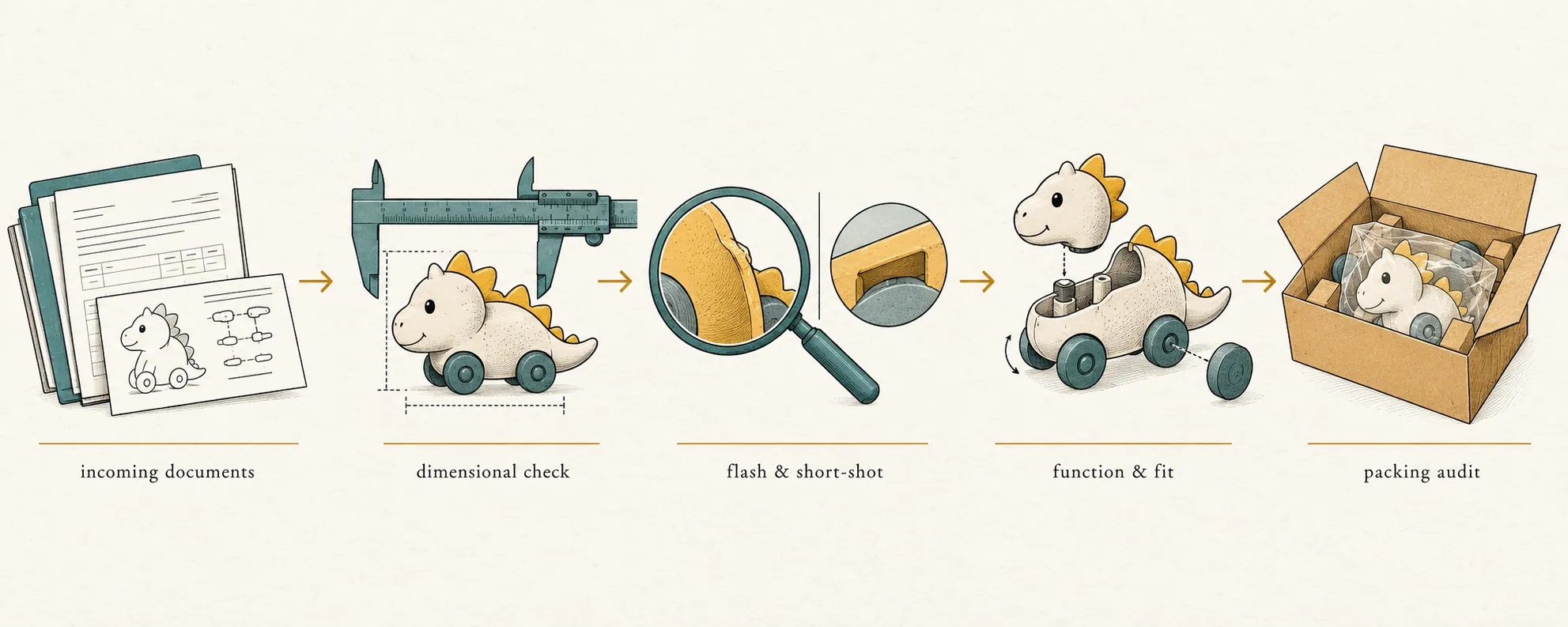
How should you organize the first-order sourcing file?
Build one revision-controlled order file, with a tracking row for each requirement and a separate approval for each financial or production commitment.
Give the file an order reference, product identifier, specification revision, destination market and named buyer approver. Store the quotation, purchase order, specifications, sample records, reports, inspection results and shipping documents under that reference. Record the supplier’s model identifier alongside your own so that different naming systems do not create a false mismatch.
Use these tracking columns: requirement; commitment blocked; owner; status; evidence reference and revision; specified target; observed result; next action and due date; closure evidence; approver and approval date. One person may hold several roles in a small business, but each action still needs a named owner.
Mark each item Complete, Missing or Not applicable—with a reason. Complete means that the record meets its acceptance criterion, not merely that an attachment arrived. A scheduled production test can be an agreed future deliverable at deposit stage; it cannot be marked as a completed test.
What must the first-order checklist contain?
| Product definition — before deposit | Owner: buyer, with supplier confirmation. Record intended use, proposed age grade and its rationale, destination, materials by component, dimensions and tolerances, functions, accessories, colors, packaging and printed languages. Acceptance: the quotation and purchase order identify the same specification revision. Next action for a gap: resolve the conflicting description before authorizing bulk production. |
|---|---|
| Supplier identity — before deposit | Owner: buyer. Record the contracting company's registered identity, business-license reference, actual producing factory, production address, quality contact and payment beneficiary. Acceptance: the roles and any differences between contracting, producing and receiving entities are explained and accepted. Next action: independently confirm unexplained differences. |
| Compliance scope — before deposit | Owner: buyer's designated compliance reviewer. Record the destination-specific requirements, applicable provisions and editions, age classification, labeling scope, planned tests, certificate or declaration responsibilities, and the official references used. Acceptance: the review covers the actual construction and identifies when each deliverable is due. Next action: close scope questions before committing to the affected construction or artwork. |
| Report coverage — before relying on a report | Owner: compliance reviewer. Compare the tested product's identity, photographs, construction, materials, accessories and age classification with the order. Record report authenticity checks and any documented coverage of variants. Acceptance: the relationship between the tested construction and ordered product is established. Next action: obtain a coverage assessment or appropriate testing for an unresolved difference. |
| Commercial agreement — before deposit | Owner: buyer and supplier. Record quantity by variant, unit and total prices, packaging, agreed minimum quantity, payment milestones, delivery basis and named place, readiness milestone, inspection rights and defect remedies. Acceptance: the signed order and quotation agree. Next action: resolve conflicting terms rather than relying on a later email explanation. |
| Sample and artwork approval — before bulk production | Owner: buyer's authorized approver. Identify the retained sample, specification revision, artwork revision, observed deviations, accepted exceptions and required corrections. Acceptance: both parties can identify the same production reference. Next action: correct and reapprove any unresolved feature before producing it in bulk. |
| Inspection and payment — agree before deposit; assess before balance | Owner: buyer and appointed inspector. Record inspection scope, sampling method if used, defect definitions, acceptance criteria, inspector, report format and failure remedy. Acceptance: the agreed result supports payment release, and blocking findings have documented closure. Next action: hold the affected release and apply the agreed correction or reinspection process. |
| Shipping and customs readiness — before dispatch | Owner: buyer, logistics provider and customs broker. Record quote inclusions, named delivery point, importing party, classification review, applicable filing arrangements, document responsibilities and shipment details. Acceptance: the document set and booking describe the same goods and quantities. Next action: correct discrepancies before dispatch and add final transport documents when issued. |
How do you check compliance scope without accepting a generic certificate?
Check the ordered construction against a product-specific compliance assessment; a familiar standard name on a document is not enough.
For a US destination, ask the reviewer to identify the applicable ASTM F963 and CPSIA provisions, whether third-party testing and a Children’s Product Certificate apply, and the relevant labeling and import-filing arrangements. For an EU destination, request the applicable conformity route, technical documentation, declaration, marking and language requirements, and relevant EN 71 coverage. These are questions for the review—not an assertion that every listed item applies to every toy.
Record the official reference, edition, product scope and applicability date used for the decision. Distinguish a rule’s publication date from the date it applies to the order. Do not copy a standard edition from an old quotation without reviewing it.
A genuine report for another model does not establish that your order complies. Compare photographs and construction details, not just model names. Different internal identifiers may describe the same construction, while similar names may conceal different accessories or materials. Wholesale Toys from China
Request confirmation of report authenticity through the issuing laboratory’s verification process. Separately establish coverage: an authentic report can still be irrelevant to the order. Do not impose an automatic annual expiry or require a new report solely because an internal product code changed; assess the tested construction, subsequent changes and applicable rules.
What do supplier records and sample approval actually prove?
Supplier records establish identity and responsibility; sample approval establishes an agreed reference, not proof of production consistency or safety compliance.
Confirm who signs the order, who makes the toy and who controls quality. A trading company is not automatically unsuitable, and a factory business license is not a product test. Keep those conclusions separate. If the payment beneficiary differs from the contracting party, obtain and verify the explanation before sending funds.
Compare the sample line by line with the written specification. Record dimensions, accessory count, function, packaging and artwork observations. Identify the retained sample with photographs and an approval label or seal, and ensure the supplier retains an equivalent reference.
Write exceptions precisely: identify the feature, the observed difference and whether it is accepted or must be corrected. If the sample has the wrong packaging, approve only the features actually accepted—not the whole order by implication.
Require written approval for substitutions affecting materials, components, accessories or artwork. The record supports traceability; it does not by itself detect an undisclosed change. Inspection and testing remain separate controls.
What should block balance payment?
Block balance payment when the agreed inspection result, due compliance deliverables or corrective-action closures have not met the purchase order’s release conditions.
Negotiate that link before paying the deposit. A published toy-import checklist recommends releasing the balance only after a passing pre-shipment inspection; use that as a purchasing condition to agree, not as a statutory payment rule. How to Import Children's Toys from China
Specify what the inspector will check: product identity, workmanship, functions, accessory count, labels, packaging and shipment quantity. If using AQL sampling, agree the sampling plan and defect classifications rather than writing only “AQL inspection.” Define what happens after failure, including correction, reinspection and responsibility for costs.
A passing sampled inspection supports the agreed batch-acceptance decision. It does not prove every unit is defect-free or replace applicable safety testing. Conversely, an open cosmetic correction need not invalidate unrelated test evidence; record which release it blocks and why.
What must be settled before the toys ship?
Settle the delivery scope, importing responsibilities and document consistency before dispatch—not after the cargo is moving.
Ask whether the quote includes origin handling, international freight, insurance, destination charges, duties, customs clearance and final delivery. “Door to door” alone does not answer those questions. Obtain written inclusions, exclusions and the named destination. Fast Boat Shipping China to USA
Build the landed-cost worksheet from product, packaging, testing, inspection, inland transport, international freight, insurance, import duty, customs clearance and local delivery. Assign each charge once so that bundled services are not counted twice. Wholesale Toys from China
Have the customs broker review the product description, classification, origin, valuation basis and applicable certificate-data filing arrangements for the destination. Confirm who is responsible for the entry rather than assuming the freight provider performs that role.
Reconcile the commercial invoice and packing list with the approved order and actual packed goods: product identifiers, quantities, carton count, weights, consignee and shipping marks. Review booking and transport instructions before dispatch; file the final bill of lading or air waybill when issued. A tidy document set supports clearance preparation but does not guarantee clearance.
How should you handle an order with mismatched accessory coverage?
| What is established? | The quotation and sample establish that the accessory is part of the proposed order. The report may remain useful for the construction it actually covers; it does not automatically cover the additional accessory. |
|---|---|
| What is the release decision? | Hold bulk-production approval for the affected configuration. Mark report coverage Missing, assign the compliance reviewer as owner, and reference the sample record and report pages showing the difference. |
| How can the gap close? | Obtain a documented assessment establishing coverage, arrange appropriate additional evaluation or testing, or remove the accessory and revise the specification, sample reference, packaging and order consistently. |
| What must not happen? | Do not treat an authentic report as coverage merely because it came from the supplier. Do not assume that changing the printed age label resolves the construction or age-classification question. |
What should the release note say?
The release note should authorize one named commitment against identified evidence, with explicit conditions and a responsible approver.
Use this copyable record: Order/product reference: __. Destination and age classification: __. Specification, artwork and sample revisions: __. Requested release—deposit, bulk production, balance payment or dispatch: __.
Specified targets and observed results: __. Supporting quotation, report, inspection and document references: __. Decision—Release, Release with stated conditions, or Hold: __. Accepted deviations and their scope: __.
Open condition: __. Commitment it blocks: __. Action owner and due date: __. Required closure evidence: __. Closure result, reviewer and date: __. Authorized approver and approval date: __.
A conditional approval must state its boundary. “Deposit approved; bulk production remains on hold pending sample correction” is actionable. “Approved subject to everything being satisfactory” is not. Close the named condition with evidence, then issue the next release rather than letting an earlier approval silently expand.