
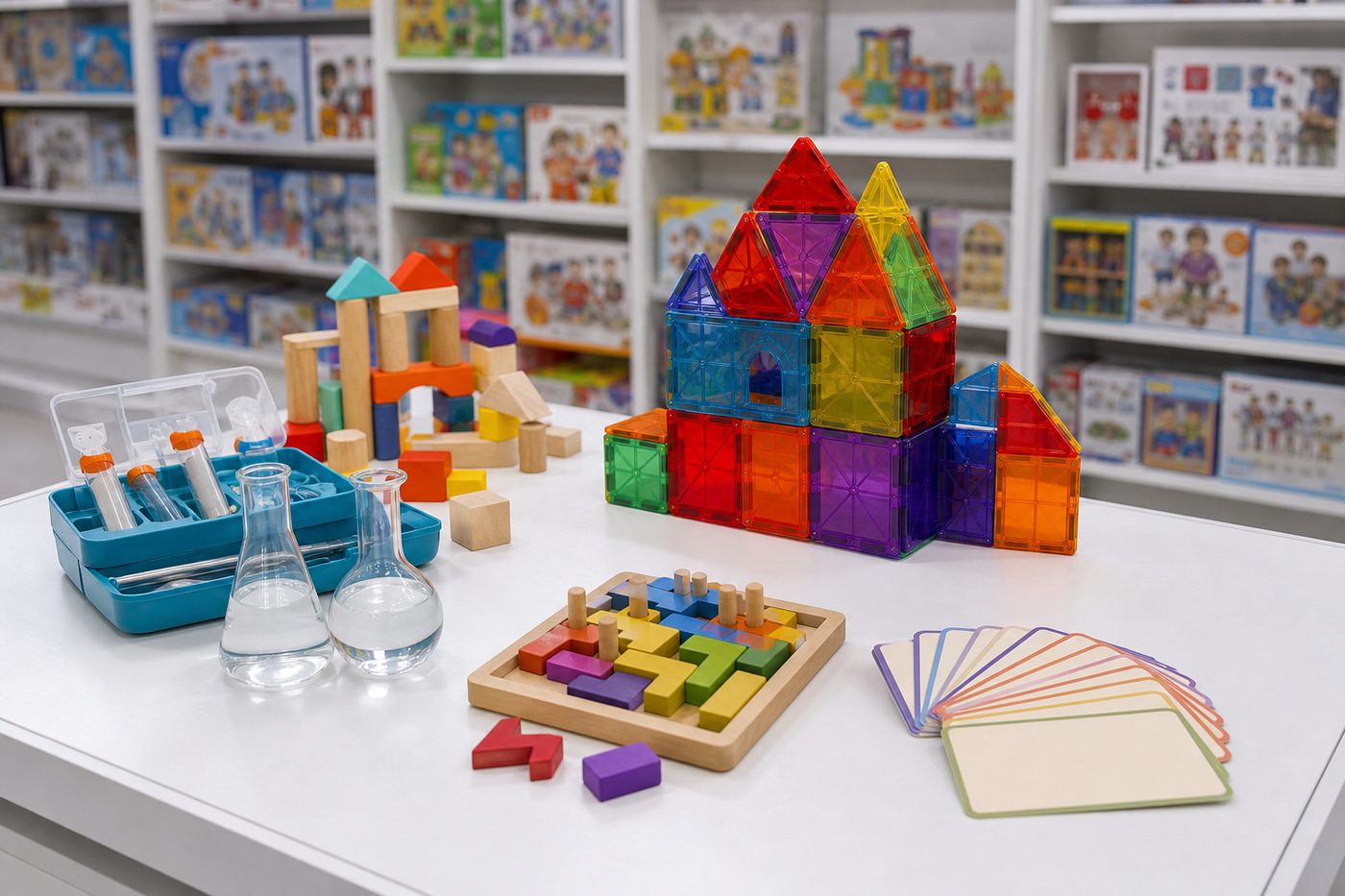
Treat STEM toy search interest as a category-level signal only, and treat order intent as something you verify at SKU level before you contact a supplier — the evidence base behind this page covers compliance and documentation, not demand data, so no search trend here can be converted into a purchase decision on its own.
A spike in STEM-labelled listings tells you what buyers are browsing, not what they will pay for. What a purchasing team can act on is narrower: age grading, small-parts assessment, destination-rule mapping, and a certificate that names the responsible party. This page covers the one change in the current window, what a buyer does with it, and the questions sourcing managers keep asking about converting interest into a first order.
The one change in this window
None in the last 14 days that changes what a STEM toy buyer must verify before ordering. The demand-side trend items available for this period point at plush, action figures and licensed collectibles — not at a new STEM category shift — so they are not STEM demand evidence.
One dated item does sit inside the window and does bear on toy imports: a European Commission press release dated 9 October 2026 on strengthened EU toy safety rules, following European Parliament adoption of the Commission's proposal. Read it as a direction of travel, not a finished rulebook — the operative text, scope and application dates have to be read from the current consolidated version before you quote anything to a supplier or a retail partner.
The second dated item is US-side and procedural rather than product-side: from 8 July 2026, importers of most regulated consumer products are required to file Children's Product Certificates electronically. That is an administrative change. It does not tell you which STEM kit sells; it tells you that the certificate itself now travels through a filing step, which raises the cost of a supplier who cannot produce SKU-level test documentation quickly.
Two structural facts also apply. The GPSR (Regulation (EU) 2023/988, adopted 10 May 2023) is a horizontal consumer-product safety framework, not a toy-specific rule, and it explicitly reaches distance selling and online marketplaces — so a STEM kit marketed into the EU through a marketplace listing still sits inside a safety framework. Separately, EU packaging-waste management and prevention measures sit under PPWR, which is a distinct review from CE marking; packaging design and waste data are their own workstream.
What a buyer does with it
Convert the signal into one verification action this week: pick the exact SKU you are considering, and ask for the document set that names it. A Children's Product Certificate is product-specific and is not a blanket factory certificate — so a supplier who sends one PDF covering "our educational toys" has not answered your question. Ask for the report that identifies the product configuration, age grade and standard edition, because a report only means something when it matches the product, age grade, material and test edition you are actually buying.
Trade terms are not evidence. FOB, CIF and DDP allocate responsibilities between you and the seller; they do not certify the toy and they do not replace CE, CPC or UKCA documentation. A cheap DDP quote is not a compliance shortcut, and a compliant factory is not automatically compliant on the specific SKU you asked about.
Age grading deserves its own line in the checklist because it is where search interest and order intent most often diverge. A kit photographed with loose magnets or small connectors reads as a STEM toy online; whether it clears small-parts requirements depends on the actual configuration, the detachable accessories and the packaging components — the same review discipline applies to all three. Assemblies that ship partly built are the usual place this gets missed.
If the kit is bundled with food — a candy-plus-experiment set, for instance — treat it as a separate assessment. A toy supplied with food can create a choking risk that differs from the toy alone.
Permanent tracking information is the last item worth confirming before you commit, since packaging wording, product markings and lot control change together and can shift with the SKU. That is also why a single catalog record proves less than it looks like it does: a reference MOQ, a reference price and a carton count establish that a listing exists, not that stock, certification or factory capacity exists behind it. In this category a reference MOQ of 36 with 12 units per carton, or 40 for a magnetic building-block set, is a starting point for a quote conversation, not a capacity statement.
For a first article or a school-account test order, the 40pcs Magnetic Building Blocks Stacking Toys set is a reasonable probe SKU: a simple plastic construction toy with a low reference MOQ, it lets you run the document request, age-grade confirmation and tracking-label check on a low-value order before you scale into kits with electronics, programming blocks or consumable components.
FAQ
Is STEM toy demand actually growing, based on this material?
The supplied evidence does not answer that. The approved sources and facts cover safety, packaging and documentation, and contain no search-volume, demand or conversion data — so any growth figure you see quoted for STEM toys is not traceable to this page. Treat demand direction as unverified until you have your own channel data.
Which categories are rising, and which should I avoid over-ordering?
The trend items available for this window point at plush, action figures and licensed collectibles rather than a STEM-specific shift, and many of those signals are retail listings rather than wholesale order data. Act on the category where your own reorder rate is measurable, not on the one with the loudest search term.
What should I request from a supplier before placing a STEM toy order?
Ask for the document set that names your exact SKU: test report identifying product configuration, age grade and standard edition, plus the Children's Product Certificate for US-bound goods. A CPC is product-specific and must not be presented as a blanket factory certificate.
Does the EU toy safety change affect toys I am already importing?
The European Commission announced strengthened EU toy safety rules, with European Parliament adoption of its proposal reported on 9 October 2026. Until you read the current consolidated text and its application dates, do not change your compliance position on the strength of a press release alone.
Are Incoterms or a supplier's CE/CPC claim enough evidence?
No. FOB, CIF and DDP allocate trade responsibilities only; they do not certify the toy and do not replace CE, CPC or UKCA market evidence. Match any certificate to a SKU, a report, a responsible party and a current version.
What is the best season to place orders?
The supplied material contains no seasonality or lead-time data, so no defensible ordering window can be given here. Work backwards from your retail calendar and add the document-review time, which is longer when a SKU needs a new age-grade or small-parts assessment.
Sources
Related Products & Categories
Need the SKU-level documents before you commit?
Send us the STEM kit you are evaluating and we will tell you which compliance fields must be confirmed per SKU — age grade, small parts, destination rules and packaging wording — and what the catalog record can and cannot establish. Browse the Educational & STEM Toys range to shortlist probe SKUs for a first document check.