
Separate product and packaging changes into linked approval tracks before accepting an OEM quotation. In Chenghai toy sourcing, changing a dinosaur alphabet set’s matching pieces changes the product; replacing its box graphics changes the packaging; changing the assortment and its printed contents list changes both. Identify the exact toy, quoted sales unit and contents first, then assign each modification its own specification, sample or proof, quotation impact and approval owner. Release production only against the combined approved revisions.
Which catalog reference matches the intended play assortment?
| Dinosaur alphabet matching set | Product ID: CHT-302888. Recorded description: 26-piece dinosaur ABC letter-matching set. Material field: Plastic. Packaging: color box. Reference MOQ: 90. Units per carton: 18. Buying consequence: preserve the matching-piece assortment in the brief and obtain a quote explicitly stating whether one sales unit is one complete boxed set. |
|---|---|
| Fishing game / water table | Product ID: CHT-307611. Recorded description: multifunction fishing game / water table toy. Material field: Plastic. Packaging: color box. Reference MOQ: 1. Units per carton: 36. Buying consequence: obtain an illustrated contents list and a complete-unit quotation before requesting accessory, color or box changes. |
| Commercial interpretation | Keep product ID, sales unit, contents count, carton quantity and MOQ as separate fields. These reference MOQs are not custom-color, logo or custom-box commitments. Carton quantity alone does not establish a full-carton ordering restriction. |
| Construction and availability request | Ask which components the Plastic material entry describes, request photographs or samples of the proposed construction, and confirm available colors, allocation and reorder conditions. A catalog color or image is not inventory confirmation. |
Is the requested modification a product change, a packaging change, or both?
| Dinosaur set: change the color of selected matching pieces | Class: product. Preserve piece identity, count and matching function. Require a component color map, color reference, agreed tolerance method and representative sample. Update packaging too if its approved images or color description would become inaccurate. |
|---|---|
| Dinosaur set: replace box graphics without changing contents | Class: packaging. Hold the product configuration unchanged. Approve the printer-specific artwork, wording and physical packing fit; do not use artwork approval as approval of the toy. |
| Fishing table: add a logo to the toy | Class: product decoration. Specify the exact surface, orientation, dimensions and proposed application process. Obtain feasibility confirmation and a decorated sample. A logo on the retail box instead belongs to the packaging track. |
| Fishing table: change the included fishing accessories | Class: product, plus packaging wherever contents, illustrations, instructions or packing fit are affected. Obtain a revised component list and sample; revise the box and insert references together. |
| Either product: change the box structure or insert | Class: packaging unless the toy or its assembly also changes. Check fit, restraint, assembly presentation and revised carton data. Route any resulting product modification back through product approval. |
| Either product: change warnings, age statements or use claims | Class: packaging or instructions, with a linked product-document review. Have the responsible reviewer approve the wording against the exact configuration and intended market; do not treat it as a purely graphic edit. |
Hypothetical OEM request: dinosaur alphabet matching set
| Identity and revision | Example brief: OEM-ABC, revision A, dated October 27, 2026. Product reference: CHT-302888. Proposed product specification: P-A. Proposed packaging artwork: B-A. Buyer product lead owns the brief. |
|---|---|
| Product and quoted sales unit | Requested quotation basis: one complete 26-piece matching set in one color box. Retain the agreed matching-piece assortment and mechanism. Supplier response: confirm the sales-unit definition, illustrated component list and requested configuration before pricing; state order quantity separately. |
| Color reference and tolerance | Requested change: recolor only the components marked on the buyer’s color map. Target: buyer-supplied physical color chip C-A. Proposed visual tolerance: separately identified light/dark and hue-limit samples, assessed under agreed D65 viewing conditions. Product lead approves the reference and acceptance method before color-sample approval. A signed center-color sample alone does not define the tolerance. |
| Logo location and process | Requested change: one-color pad-printed logo on the outward-facing surface of the component marked L1 in the buyer’s annotated photograph. The drawing must fix logo size, orientation and position. Supplier response: confirm print-area suitability and process feasibility, or submit an alternative for approval. Product lead compares the decorated sample with the approved drawing. |
| Packaging artwork and wording | Requested change: retain the color-box format and replace graphics using artwork B-A. Include the approved product name, contents statement, instructions, barcode and destination-specific wording agreed by the responsible reviewer. Packaging lead obtains the selected printer’s dieline, file format and bleed requirements, then approves the proof and packed sample. |
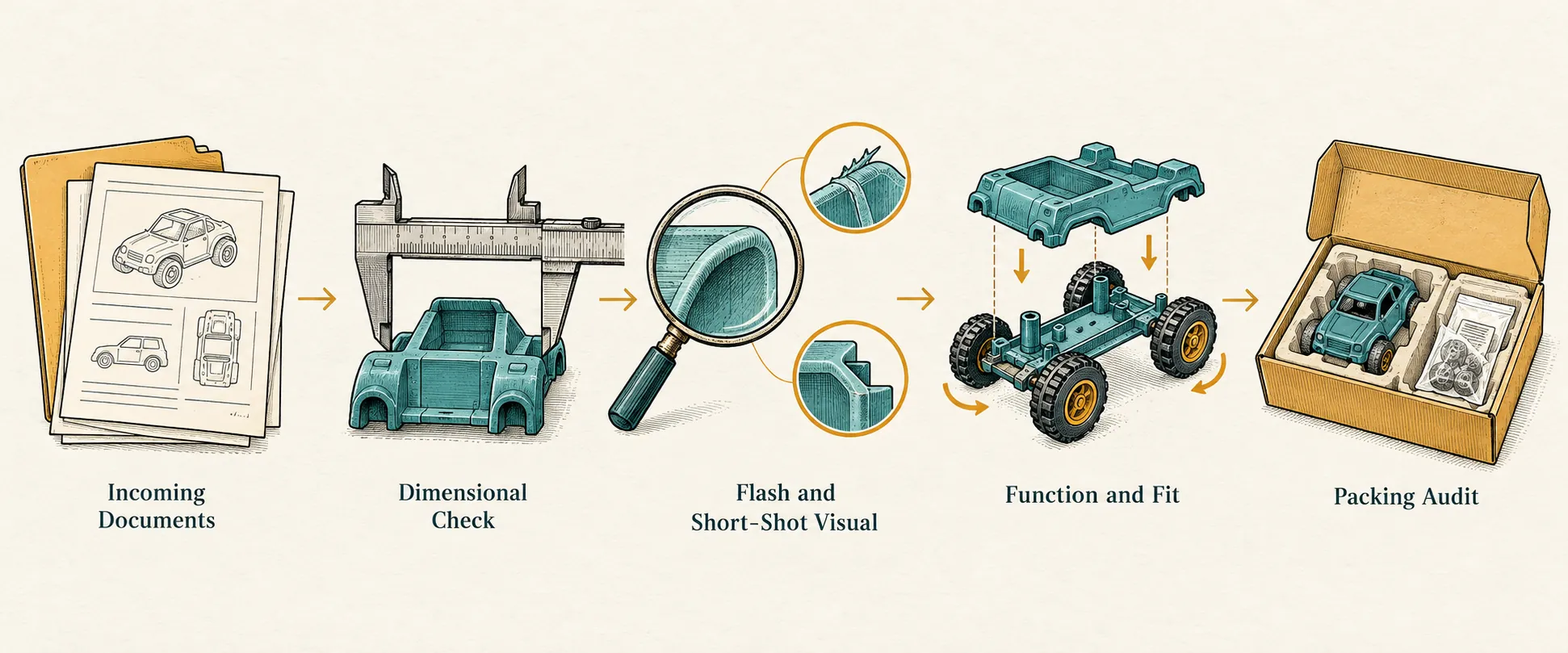
| Specified target versus observed result | Product inspection record: compare actual piece count and identity, matching action, component colors and logo placement with P-A. Packaging record: compare printed text, images, barcode and packing fit with B-A. Record observations against each target when the samples arrive; do not substitute a general signed-sample note. |
| Decision, approvers and dates | Example decision: hold production release until product, artwork and packed-sample conditions are closed. Product lead signs product approval; packaging lead signs artwork and packing approval; purchasing signs the configuration-specific quotation. Each records their name, actual decision date and any conditions. |
| Approved sample and change closure | Assign the approved physical sample a unique identifier and attach photographs linking it to P-A and B-A. For any later change, record the old requirement, proposed revision, affected approvals, responsible owner and closure evidence. Release only when the authorized approvers close the conditions and purchasing identifies the final revision pair. |
How should unchanged-product, packaging-only and combined routes be quoted?
| Route A: unchanged product and existing packaging | Quote one complete set with the agreed contents and existing box. Confirm the offered colors, current availability, configuration-specific MOQ, carton quantity, sample route and reorder conditions. |
|---|---|
| Route B: unchanged product with revised packaging | Use the same complete-set basis and contents as Route A. Separate box or label changes, artwork proofing and packing work. Ask whether the revised packaging affects minimum quantity or carton configuration. |
| Route C: changed product and revised packaging | Keep the complete-set unit explicit and list the color and logo changes against Route A. Quote applicable decoration, sampling and packaging work separately. Identify any actual tooling or development requirement rather than assuming new tooling is necessary. |
Which approvals come before production release?
Approve the product sample and packaging artwork separately, then verify them together in a packed pre-production reference.
Agree the configuration and quotation basis first. Supplier inquiry is appropriate while defining scope: use the reply to resolve component identity, decoration feasibility and the relevant quantity constraints before commissioning the approval samples.
Product approval covers the agreed contents, function, color acceptance and decoration. Artwork approval covers the correct file revision, graphics and wording. The packed sample then checks whether the approved toy, instructions and packaging work together. Separating sample approval, artwork confirmation and production specifications follows the process described in Toy Sourcing Process.
Before release, reconcile the quotation with that final configuration. Separate product quantity, applicable tooling or development, testing or inspection scope, carton and shipping assumptions, payment terms and quote validity rather than burying them in one price. This is a purchasing recommendation reflected in Custom Toy Quantity Planning, not a fixed commercial rule.
The release record should identify the approved sample, product revision, packaging revision, decision, conditions, named approvers and dates. It supports traceability; it does not by itself prevent an undisclosed substitution. Use production checks against those references as well.
What must be confirmed before the order is released?
| Sales unit and current quotation | Owner: purchasing. Request the exact configuration, complete sales-unit definition, current quote, applicable minimums, validity and payment terms. Closure: accepted quotation matches the released product and packaging revisions. |
|---|---|
| Availability and repeat orders | Owner: supplier commercial contact, reviewed by purchasing. Request the offered colors, quantity availability and reorder conditions for this configuration. Closure: written confirmation identifies the configuration and the period or order to which the offer applies. |
| Samples and inspection scope | Owner: buyer product lead. Agree which samples demonstrate the product, decoration and packed configuration, and which checks remain for production. Closure: identified samples, recorded observations and signed decisions resolve the specified conditions. |
| Wording and product-document review | Owner: buyer’s designated product-compliance reviewer. Request documents tied to the exact model, construction, intended use and destination; review proposed age statements, instructions and claims before artwork release. Closure: recorded wording approval and any necessary follow-up review or testing decision. Commercial sample approval is not safety testing. |
| Packaging and carton confirmation | Owner: packaging lead. Request the final artwork revision, packed-sample confirmation, carton count and carton data for the approved configuration. Closure: the packing specification and quotation agree; any full-carton ordering condition is stated explicitly. |
| Later changes | Owner: brief owner, with the affected approvers. Require a written change request identifying what changes and what remains unchanged. Closure: revised sample or proof evidence where needed, reapproval dates and an updated production-release record. |