
Approve product dimensions for the toy’s assembled or intended-use footprint, retail-packed dimensions for shelf fit, and master-carton dimensions for shipment planning—never substitute one for another. For Chenghai toy sourcing, an unlabeled catalog size is not enough to approve any of those three measurements. Keep dimensional approval on hold until the supplier identifies the measurement level, confirms the case pack, and links the measurements to the exact product and packaging revision.
The distinction matters for different mechanisms. A dinosaur whack-a-mole game with music and lights needs a defined playing footprint. A golf set with a putting mat and tees needs its unpacked play layout distinguished from its boxed configuration. Neither product’s use-space dimensions can safely be inferred from a generic catalog size.
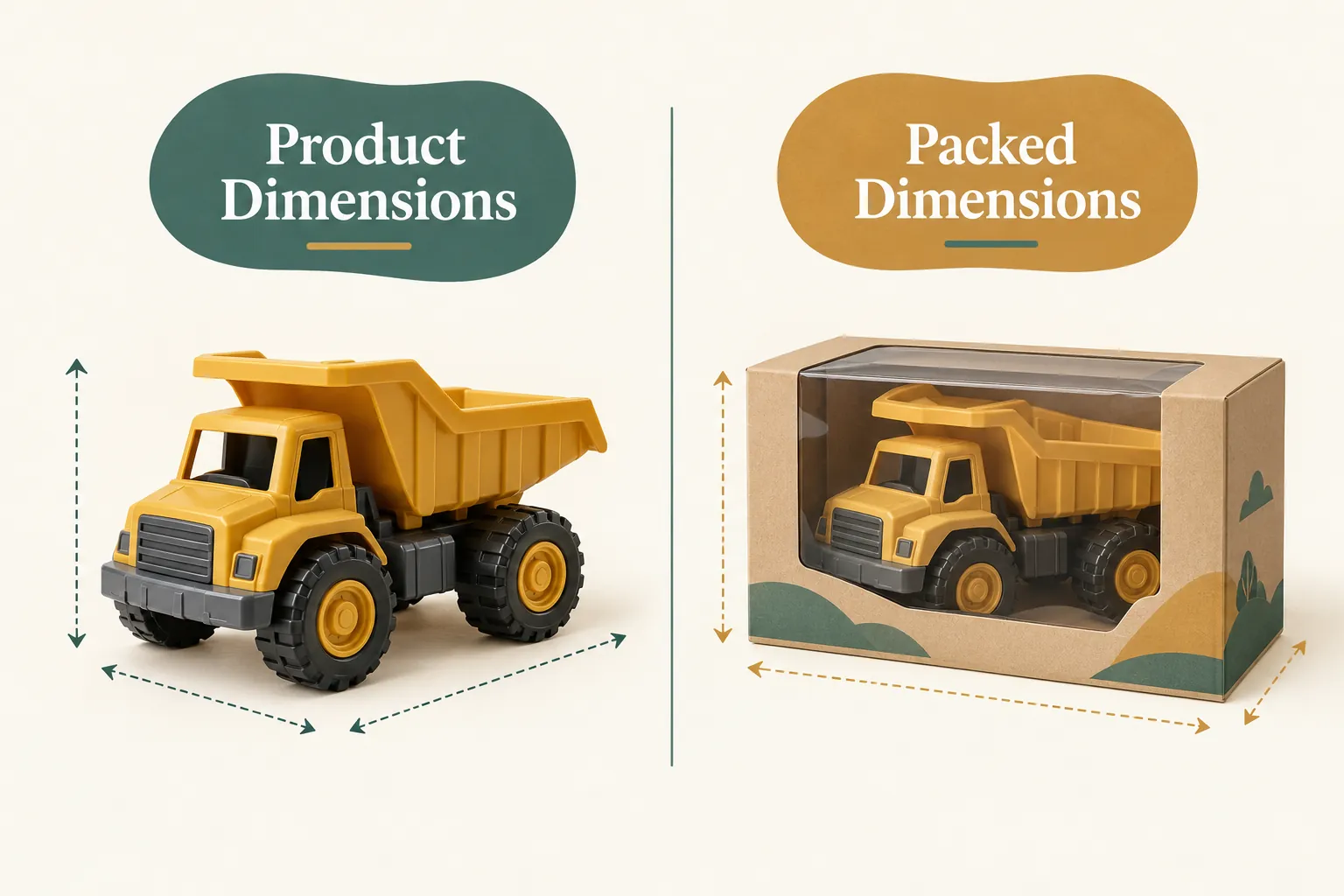
Which dimensions describe the toy, the retail pack and the shipping carton?
| Product dimensions | Request length × width × height, units and configuration: assembled, folded or disassembled. For a multi-piece playset, specify whether the measurement covers the main item, each component or the intended play layout. Use this field to assess product fit and assortment presentation. |
|---|---|
| Retail-packed dimensions | Request the external length × width × height of one complete selling unit in its approved packaging, including any protruding handle or hanging tab relevant to display. Use this field for shelf, display and individual-pack fit. |
| Master-carton dimensions | Request the external length × width × height of the closed, loaded export carton, together with selling units per carton. Use this field for shipment-volume planning. Do not substitute retail-box dimensions or multiply product dimensions to estimate the outer case. |
What can buyers approve from these two catalog examples?
| Dinosaur whack-a-mole game — item reference CHT-303159 | Product dimensions: request labeled playing-configuration measurements. Retail-packed dimensions: request separate external measurements. Master-carton dimensions: request loaded-carton measurements. Recorded size: 45 × 12 × 30 cm, measurement level to be identified. Packing description: single item. Reference MOQ: 36. Units per carton: request written confirmation. Source: October 9, 2026 catalog snapshot, asset 9837. Status: missing measurement classification and case-pack confirmation. Decision: hold dimensional/order release. Follow-up owner: buyer to assign a named supplier contact to return a revised dimension sheet and carton count. |
|---|---|
| Golf game set with putting mat and tees — item reference CHT-305382 | Product dimensions: request unpacked component or play-layout measurements, clearly identified. Retail-packed dimensions: request external color-box measurements. Master-carton dimensions: request loaded-carton measurements. Recorded size: 41 × 13 × 23 cm, measurement level to be identified. Packing description: color box. Reference MOQ: 48. Recorded units per carton: 24. Source: October 9, 2026 catalog snapshot, asset 9837. Status: missing measurement classification; MOQ and carton count are catalog-recorded, pending order confirmation. Decision: hold dimensional/order release. Follow-up owner: buyer to assign a named supplier contact to identify the size field and confirm that each counted unit is one complete golf set. |
Does MOQ tell you the carton count or order multiple?
MOQ sets a minimum quantity; it does not establish an order multiple or identify the shipping carton’s size.
For the golf set, a proposed order of 48 units meets the catalog reference MOQ of 48. At the recorded 24 units per carton, 48 ÷ 24 gives two full cartons with no remainder, provided the supplier confirms the same selling-unit definition and case pack for the order. That arithmetic does not prove that every order must be a multiple of 24.
For the dinosaur game, the reference MOQ of 36 does not establish how many cartons the order occupies. Request the carton quantity rather than treating 36 as a case pack. A packing description of “single item” identifies neither the export-carton count nor its dimensions.
Calculate shipment volume only after the master-carton measurements are confirmed: carton length × width × height in centimeters ÷ 1,000,000 gives cubic meters per carton. The golf set’s unlabeled 41 × 13 × 23 cm size must not be used as its master-carton size.
What written confirmation closes the dimension hold?
Close the hold with a revised dimension sheet tied to the exact toy and packaging, supported by clearly labeled measurements rather than an unexplained replacement number.
Send this request: Identify whether the catalog size refers to the toy, the retail pack or the master carton. Return separate length × width × height measurements in centimeters for each applicable level. State the toy’s measured configuration, the complete contents of one selling unit, the units per master carton, and whether the quoted MOQ has any separate order-multiple restriction.
For the dinosaur game, add a specific request for the export-carton count. For the golf set, ask whether the recorded size describes the color box and request the unpacked mat and relevant component dimensions separately. A color-box packing description is not proof that the adjacent size field measures that box.
Use a sample to resolve measurements where necessary. Photograph the measured configuration with the measuring tool visible, identify the sample and packaging revision, and compare the observations with the supplier’s proposed specification. A sample supplied without its final export carton can support product-size review, but not final master-carton approval.
What belongs in the one-page dimension approval record?
| Identity and revision | Enter the item reference, product description, supplier, sample identifier, dimension-sheet revision and packaging revision. Retain the catalog date as the starting source, not as a substitute for the current revision. |
|---|---|
| Specified target versus observation | For product, retail pack and master carton, record the agreed target beside the measured observation, measurement units and configuration. Link each value to the dated supplier sheet, sample measurement or packing record that supports it. |
| Quantity basis | Record the proposed order quantity, current confirmed MOQ, complete selling units per carton and any explicitly agreed order multiple. Keep these as separate fields. |
| Status and follow-up responsibility | Assign confirmed, missing or conflicting to each required field. For every open field, name the person responsible, the exact correction or measurement requested, and the response due date. |
| Decision and conditions | Record approve, hold or reject, and state the scope: product-size approval, retail-pack approval or shipping-carton approval. Identify any condition that must close before the relevant release. |
| Approver and closure | Enter the responsible buyer or approver’s name and decision date. Close each action with the accepted evidence reference, closure date and approver. Retain superseded revisions so the decision remains traceable. |
When should the buyer approve, hold or reject?
Approve when the relevant measurements are identified, checked and within the buyer’s agreed limits; hold when a required value or discrepancy remains unresolved; reject a proposed configuration when a confirmed measurement fails a non-negotiable requirement.
Keep the decision scoped. A verified toy footprint can pass product-size review while the retail box or export carton remains on hold. Neither example above needs to be rejected merely because its catalog size is ambiguous, but neither supports final shipping-dimension approval as recorded.
If a revised pack changes an approved dimension, reopen the affected review and update the order-file reference. The record supports traceability; it does not by itself reveal an undisclosed packaging change.