
Approve a packaging sample only when its barcode, warnings and inserts, packed carton, and shipping records match the identified production specification—or carry explicit conditions that block the affected release. Run the packaging sample review in that order: scan the finished sellable unit, inspect its contents and copy, measure and assess the closed shipping carton, then reconcile the documents. Record the evidence, discrepancy, owner, and decision at each stage so production receives a usable standard, not a vague approval.
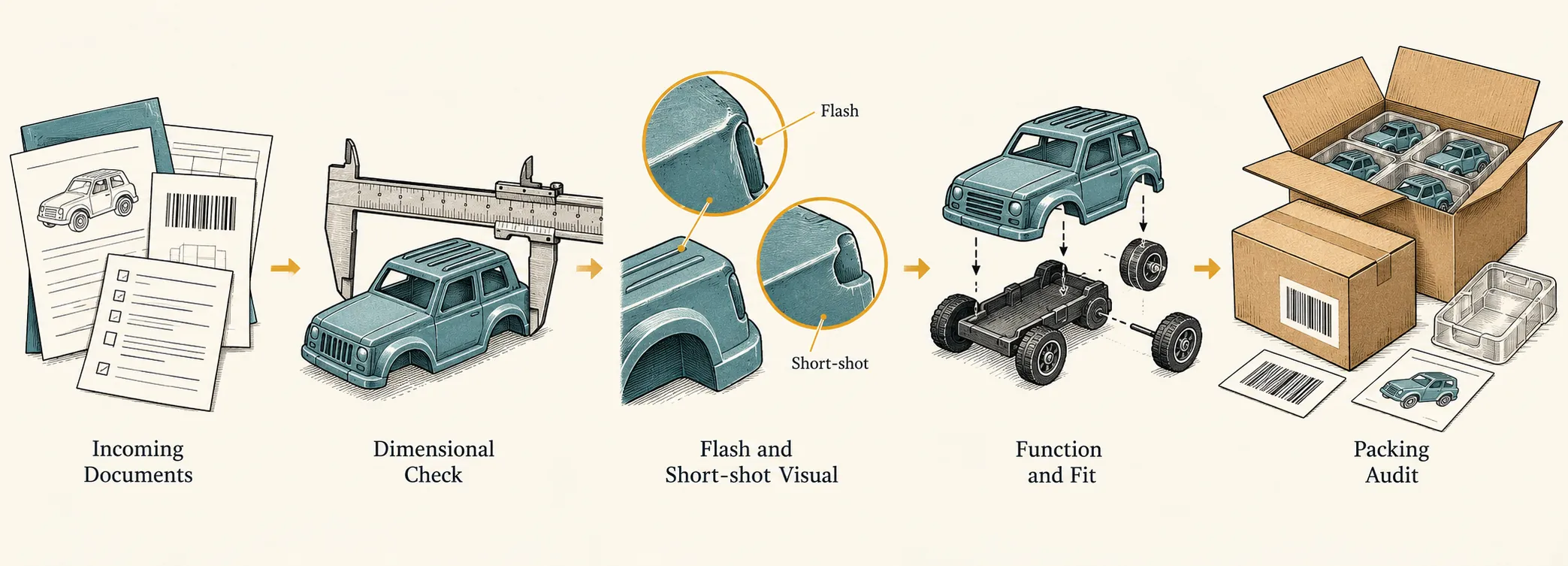
What exactly does the packaging sample approval cover?
Packaging approval covers the identified sample configuration and controlled specifications, not every later production unit or a different packout.
Before inspection, assign a sample-set ID and record the product or set identity, intended destination and receiving channel, sample date, artwork revision, barcode assignment, insert revision, carton drawing, material specification, finish reference, dimensions, and buyer-agreed tolerances. Identify the evidence files by revision rather than attaching an unnamed collection of photographs.
State how the sample was made and what it represents. A digital proof can support copy and layout review, but it cannot establish physical fit, final printed color, paper texture, embossing depth, or metallic appearance. A structural prototype supports fit checks; finished print and finish still need an appropriate physical reference. Packaging Sampling Guide
Ask the supplier to document any expected differences between the sample process and production process before approval. Decide which differences are acceptable and which require another sample. A low-quantity pre-production sample may not reproduce every detail of mass production, but that is not permission to substitute materials, finishes, or construction without review.
Use four inspection gates: unit barcode first, warnings and inserts second, packed carton third, and shipping records last. This order avoids approving a carton arrangement that must be reopened because the sellable unit needs relabeling or another insert.
Does the barcode identify the correct sellable unit after packing?
Accept the unit barcode only when its decoded value matches the approved item record and it remains accessible on the finished sellable pack.
Compare the physical label with the controlled barcode file and item master. Scan the actual printed sample using the intended receiving equipment where available; save the decoded value and the receiving-system item result. A successful scan of the wrong item is still a mismatch.
Inspect placement on the fully assembled pack, not just the flat artwork. Check for folds, seams, glare, distortion, protective wrap, sleeves, or inserts that obstruct the scan area. Photograph the barcode both close up and in its full-pack position. Planning a clean, flat, scannable area during artwork approval is a useful purchasing practice. FBA Packaging Checklist
If the value is wrong, the buyer's item-data owner must correct the assignment or file. If the value is right but scanning fails, the packaging owner must revise placement or print execution and submit another packed sample for rescanning. A routine receiving scan is an operational check, not formal barcode print-quality verification.
Where the receiving channel uses both unit and shipment-carton labels, review them separately. In an FBA workflow, carton-level shipment labels do not replace the product-level barcode; have the seller or fulfillment team supply the applicable final files.
Do warnings, inserts, and accessories match the approved pack?
Accept warnings and inserts only when the approved copy is present, readable, correctly positioned, and compatible with the complete packed unit.
Pack the actual product with every planned accessory, manual, insert card, separator, and protective wrap. If a dimension-accurate substitute is used, identify it and limit the conclusions accordingly: a fit dummy does not establish actual packed weight or product protection.
Compare wording, language, symbols, revision, and placement with the buyer-approved destination artwork and insert register. Inspect the pack after closure: an insert should not hide required information, obstruct the barcode, distort the box, or prevent the intended closure. Testing the product with its actual accessories and inserts matters because a product that fits alone may not fit once everything is included. Packaging Sampling Guide
Record an omitted insert, outdated warning panel, unreadable print, or forced closure as a specific discrepancy. Assign copy questions to the buyer's designated labeling reviewer; assign placement and fit corrections to the packaging engineer. Require revised evidence or a replacement packed sample before releasing the affected packaging.
This inspection checks execution against approved instructions. It does not establish that warning wording is legally sufficient or that the toy is safe. Keep product-safety testing and destination-specific compliance review as separate release checks.
What must be checked on the closed shipping carton?
| Closed external dimensions and units | Record: approved carton drawing, measurement convention, and dimensional tolerance. Observe: external length × width × height of the sealed, filled carton, with cm or mm stated explicitly and a photograph showing the measurements. Discrepancy: dimensions outside the agreed range, unexpected bulging, or inconsistent units. Decision: the packaging engineer reviews fit and construction; the logistics owner updates volume data if an accepted change affects shipment planning. |
|---|---|
| Inner packs and units per carton | Record: approved packing instruction and contents list. Observe: actual units per inner pack, inner packs per master carton, total units, and any mixed assortment. Discrepancy: missing pieces, a changed assortment, or a different layer arrangement. Decision: QC recounts and corrects the packout, then records the corrected count and photographs before resealing. |
| Gross weight, net weight, and tare | Record: approved weight definitions and proposed packing data. Observe: measured gross weight of the closed carton, scale identification and units; establish net weight from actual contents and document packaging tare where used. Discrepancy: a mismatch beyond the agreed range or inconsistent weight definitions. Decision: QC checks count and components before the shipping team changes the documents; do not alter the packing list merely to hide the difference. |
| Carton construction and strength | Record: approved board construction or grade, joint and closure specification, plus any buyer-specified strength requirement and supporting result. Observe: supplied construction, seam condition, closure, crushing, tearing, and deformation under the actual packout. Discrepancy: substituted board, damaged joints, or strength evidence that does not cover the approved construction. Decision: the packaging engineer requests replacement material or the agreed test evidence. Thickness, a hand squeeze, or appearance alone does not establish compression performance. |
| Protection and packing direction | Record: approved layer diagram and packout photographs. Observe: orientation, separators, contact points, voids, and closure clearance. Discrepancy: a changed arrangement, missing protection, or pressure on retail packs. Decision: revise the packing instruction and review another fully packed carton before accepting the changed arrangement. |
| Shipping marks and carton labels | Record: approved shipping-mark proof, carton numbering scheme, and receiving instructions. Observe: printed or applied identifiers, quantities, destination information, handling symbols, and label visibility. Discrepancy: wrong order reference, unreadable printing, inconsistent carton numbers, or a label crossing a closure seam. Decision: the shipping coordinator issues corrected artwork or labels and QC records the corrected carton before release. |
How should CBM and preliminary packing data be handled?
Use proposed packing data for pre-PO planning, then replace or validate it with final measurements from the actual production packout before shipment.
Keep separate records for proposed dimensions and weights, sample measurements, and final packed shipment measurements. An approved sample establishes the intended configuration; it does not establish the final number of cartons or prove that every production carton matches it.
Explicitly hypothetical CBM example: a closed carton measures 50 cm × 40 cm × 30 cm. Carton CBM = L(cm) × W(cm) × H(cm) / 1,000,000 = 50 × 40 × 30 / 1,000,000 = 0.060 m³. For 100 identical cartons, total carton volume = 0.060 × 100 = 6.000 m³. This is carton volume, not a palletized shipping envelope.
Use final external measurements, including any bulging. Calculate different carton sizes separately, and identify partial cartons rather than assuming that every carton has the same contents or dimensions. A catalog figure applies only to its exact item and pack configuration.
If final measurements differ, assess them against the agreed tolerance and receiving constraints. An acceptable dimensional change may require revised volume data rather than rejection; a changed packout or construction may require renewed packaging approval.
Which shipping records must reconcile with the packed cartons?
Reconcile the packing list and shipment-label register with the final physical carton count, contents, marks, weights, and dimensions—not just the approved sample.
Before production, review the proposed packing-list structure and carton-mark proof. At final packing, enter actual quantities and measurements. Match order and item references, units per carton, carton-number ranges, mixed or partial cartons, total units, and weight and volume totals. Check corresponding item references and quantities on the commercial invoice where applicable.
If a discrepancy appears, identify which record or physical result is wrong. A count error calls for a recount; an obsolete label calls for relabeling; an accepted packing change calls for controlled document revision. Do not make paperwork agree by copying an unverified number across every file.
Have the shipping coordinator issue the corrected revision and QC verify the affected cartons. The buyer's designated approver then closes the discrepancy with dated evidence. Keep destination-specific regulatory documents in their own release review rather than treating this packing reconciliation as a compliance or customs-clearance decision.
Packaging sample sign-off record
| Barcode — approved | Target: assigned unit barcode and placement in artwork Rev B. Observation: decoded value matches the item record and remains accessible after final wrapping. Evidence: scan log BC-01 and packed-unit photos P-01/P-02. Owner: Alex, buyer QC reviewer. Decision: approved by Alex on October 27, 2026. Next action and closure: retain the checked label file with the approval set; no open correction. Changes to barcode value, position, or covering material require review. |
|---|---|
| Warnings and inserts — rejected for revision | Target: insert Rev B and approved warning panel. Observation: sample contains insert Rev A; warning-panel execution matches the approved artwork. Evidence: contents photo P-03 and marked comparison IN-01. Owner: Morgan, supplier packaging lead. Decision: insert configuration rejected by Alex on October 27, 2026; the warning-panel check remains valid. Next action: submit the corrected packed unit and insert photo by October 29, 2026. Closure: open until Alex records acceptance of the replacement; insert printing and affected packout remain blocked. |
| Closed carton — approved for the sampled configuration | Target: carton drawing and packaging specification Rev B. Observation: the closed sample measures 50 × 40 × 30 cm; count, weights, construction, closure, and arrangement meet the referenced buyer criteria. Evidence: measurement and weight sheet CT-01, count record CT-02, construction/strength evidence CT-03, and packing-direction photos P-04/P-05. Owner: Alex, buyer QC reviewer. Decision: sample configuration approved on October 27, 2026. Next action: Morgan applies the same controlled packout in production; production results remain subject to final packing checks. |
| Shipping documents — approved with a final-packing condition | Target: carton marks matching the order and a packing list populated from final packed results. Observation: mark proof matches the approved references; draft packing list still contains proposed measurements and quantities. Evidence: mark proof MK-01 and draft packing list PL-01. Owner: Sam, shipping coordinator. Decision: document format approved with condition by Alex on October 27, 2026; not shipment release. Next action: Sam issues the final packing list after packing and before shipping release. Closure: Alex signs the reconciliation of actual carton count, contents, weights, dimensions, and labels; currently open. |
How should written approval control production and later changes?
Issue approval only for the named version, state exactly what remains blocked, and close each condition with evidence and a dated decision.
For the hypothetical record above, the written decision would read: “Sample set PS-01, reviewed October 27, 2026, is approved with conditions against pack artwork Rev B, insert Rev B, carton drawing Rev B, and packaging specification Rev B, including its material specification, finish reference, dimensions, and agreed tolerances. The submitted Rev A insert is rejected. Revised insert evidence must be accepted before insert printing and affected packout are released. Final shipping release remains conditional on reconciliation of the actual packed cartons with the final packing list and labels. Alex is the buyer approver; Morgan owns the insert correction and Sam owns final shipment-record reconciliation.”
In a live approval, identify the full name and role of each responsible person, the approval date, each corrective-action due date or release gate, and the closure evidence reference. Replace an open condition with a recorded accepted or rejected result; do not silently delete it.
Retain the approved physical sample and controlled file set as the reference for production and repeat orders. Written approval should identify the artwork revision, material specification, dimensions, finish, and agreed tolerances. Packaging Sampling Guide
Require renewed review for changes affecting barcode identity or access, warning or insert copy, material, finish, carton size, strength specification, pack count, or packing direction. Compare production packing with the approved reference using the buyer-agreed inspection plan. The record supports traceability; it does not by itself prevent or reveal an undisclosed substitution.