
Accept a Children's Product Certificate for a shipment only after matching its product identity, seven required elements, and supporting evidence to the goods being imported. Start with the purchase order and production records; check the certificate fields; trace each cited rule to testing or an applicable exemption; review product changes; then record an accept, hold, or reject decision. Assign every discrepancy to a named owner with a specific correction and deadline. Certificate text cannot replace product testing or professional compliance review.
This workflow concerns US-bound children's products: products designed or intended primarily for children 12 years of age or younger that are subject to applicable CPSC children's product safety rules. CPSC guidance describes the third-party testing and certification requirements, subject to applicable testing exceptions and determinations. CPSC CPC guidance
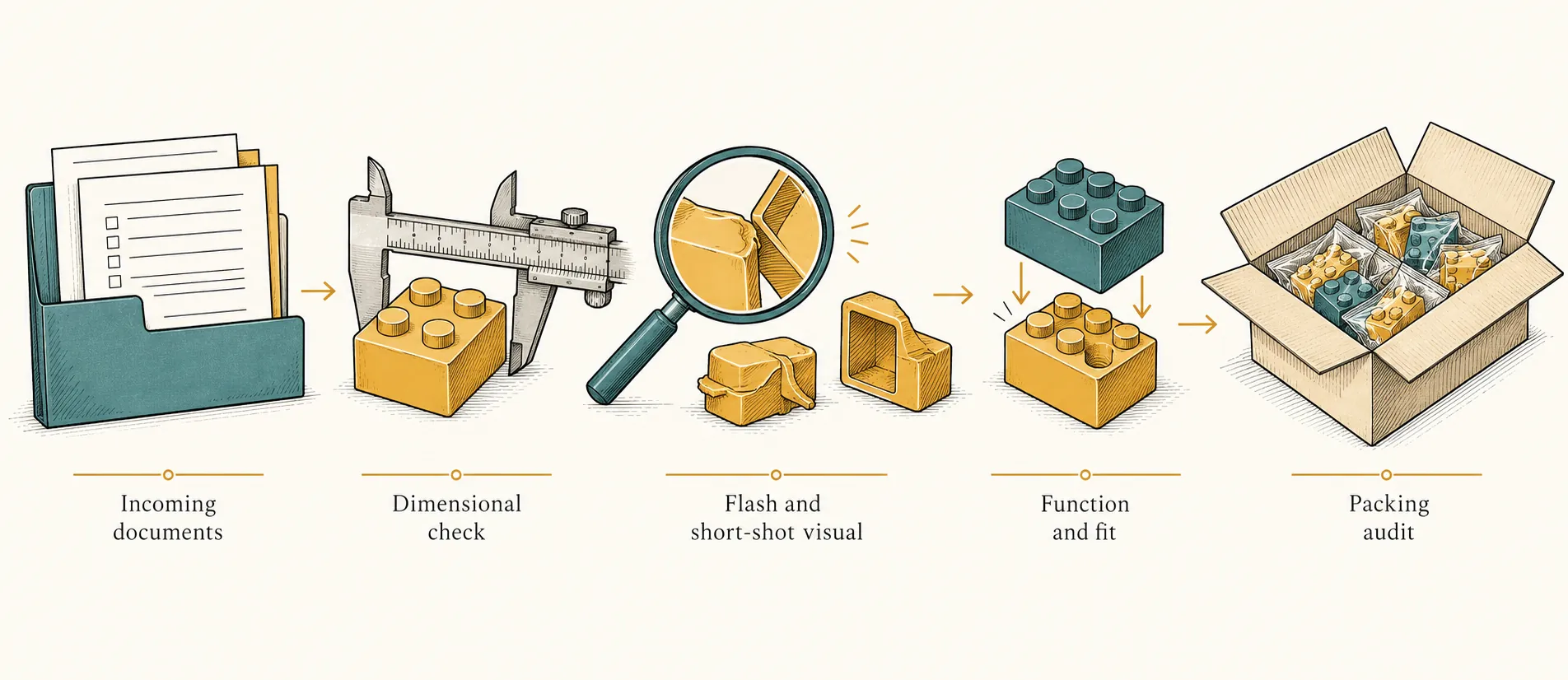
What shipment reference should the reviewer establish first?
Establish one controlled shipment reference before reading the CPC so that every certificate statement is compared with defined goods, not a catalog description.
Have the shipment owner assemble the purchase order and revision, commercial invoice or packing list, product model and internal item mapping, approved specification, materials and color variants, production date or batch, manufacturing location, and US destination. Use production records and photographs where they help distinguish similar versions. These are recommended review controls; they are not all separate mandatory CPC fields.
Identify the CPC version being reviewed and the supporting report numbers and revisions. If the supplier uses a different model number, require a written cross-reference tied to the actual construction and shipment records. A similar product name is not an adequate substitute.
Use one line per review item with these fields: specified target; observed value; exact evidence reference and page; named responsible person; pass, hold, or fail status; next action and due date; closure evidence; and approver/date. The checklist below supplies the targets and actions. Enter shipment-specific observations rather than treating the checklist itself as evidence.
Which seven CPC elements should importers match?
| 1. Product identification | Target: the certificate identifies the covered product sufficiently to connect it to the shipped goods. Evidence: CPC product description and identifiers, purchase order, packing list, approved specification, and report sample identification or photographs. Owner: importer product manager, supported by supplier quality. Action for a mismatch: obtain a documented model/variant cross-reference or a corrected CPC; hold the affected product line until the connection is established. |
|---|---|
| 2. Each applicable safety rule | Target: the CPC identifies each applicable children's product safety rule specifically. Evidence: the product-specific applicability assessment and the report sections or documented exemption supporting each citation. Owner: importer compliance lead. Action for an omission or generic 'ASTM compliant' statement: identify the applicable rule and relevant provisions, map them to supporting evidence, and have the issuer correct the CPC. Escalate uncovered requirements for testing or professional review. |
| 3. Certifying importer or domestic manufacturer | Target: the responsible certifying party is identified with its name, address, and telephone number; for imported products, the importer issues its own CPC. Evidence: importer entity records, shipment records, and issuer details on the CPC. Owner: importer compliance lead. Action if only the overseas factory is the certifier: obtain and evaluate the underlying evidence, then arrange issuance of the importer's own CPC rather than forwarding the factory's certificate. |
| 4. Person maintaining test records | Target: the CPC identifies a reachable individual maintaining the test records, with the required contact details. Evidence: the named contact's details and a successful retrieval of the referenced reports and supporting records. Owner: importer records custodian. Action if the contact or records cannot be reached: obtain corrected contact information and retrieve the evidence before closing this item. Record the retrieval result, not merely that an email was sent. |
| 5. Date and place of manufacture | Target: the manufacturing date and location describe the covered goods. Evidence: factory production records, batch records, and shipment allocation records compared with the CPC. Owner: supplier production or quality representative, reviewed by the importer shipment owner. Action for a discrepancy: reconcile the factory, production period, and shipment allocation; request a corrected CPC when its manufacturing information is inaccurate. |
| 6. Date and place of testing | Target: the CPC's testing information agrees with the supporting test record. Evidence: report number and revision, test dates and location, sample identification, and the documented link to the shipped construction. Owner: importer compliance reviewer. Action for inconsistent dates or locations: reconcile them against the laboratory record and correct inaccurate certificate text. If the report covers a different construction, route the issue to a coverage assessment rather than simply changing the date. |
| 7. Third-party laboratory identification | Target: the CPC identifies the laboratory supporting certification, subject to applicable testing exceptions or determinations. Evidence: the report's laboratory identity and contact details, together with the laboratory's CPSC acceptance for the relevant testing scope. Owner: importer compliance reviewer. Action for a laboratory mismatch: obtain the correct report and laboratory details, assess the relevant acceptance scope, and require correction or appropriate testing before approval. Do not replace a laboratory entry with a blanket exemption statement. |
Can an importer use the overseas factory's CPC or test reports?
An importer cannot simply pass along a foreign manufacturer's certificate, but it may use qualifying foreign test results or certifications to support its own CPC.
CPSC explains that reliance under 16 CFR part 1109 requires the importer to exercise due care regarding the validity of the results or certification and receive the documentation required by that rule. Receiving a PDF is not, by itself, the full review. CPSC testing FAQ
Assign the importer compliance lead to trace every CPC rule citation to the relevant report section or documented exemption. Record the tested model, sample photographs, material or component identification, color coverage where relevant, and the connection to the shipped construction. Retrieve referenced supporting records rather than relying only on a report cover page.
Do not reject a report merely because testing predates the shipment's production date. Equally, do not assume that a type-test report covers every later production lot. Review the construction history, changes, production linkage, and applicable continuing-testing obligations. Neither a new internal item number nor a later shipment date automatically requires an entirely new test report.
How should testing exemptions appear in the review?
Treat a testing exemption as a rule-specific evidence route, not permission to omit the CPC or disregard other testing requirements.
Where an applicable regulatory exception, exemption, or CPSC determination removes testing for the covered product or material, CPSC guidance still calls for certification: cite the applicable regulation and identify the claimed exception or exemption instead of a laboratory for the untested coverage. Keep laboratory information for other rules supported by testing. CPSC CPC guidance
Add an exemption review entry identifying the specific provision, the product or component it covers, and the material or construction evidence supporting eligibility. The importer compliance lead owns this assessment. If the claim is too broad or does not fit the actual goods, hold that item and require either a supported narrower claim or the appropriate testing evidence.
When does a product change require more than a corrected CPC?
| Paint supplier changes; other components and finished-product compliance are unaffected | Specified target: evidence supports the paint used in the shipment. Observation for this example: the paint supplier changed after the earlier testing. Decision: hold certificate approval pending assessment and supporting evidence. Evidence to collect: change record, identification and traceability of the replacement paint, new component results, and relevant earlier product results. Responsible owner: importer compliance lead, assigned by name in the shipment record. Next action: document why the change does not affect other compliance coverage and obtain the new supporting paint results. Closure: review the combined evidence and issue a new CPC when justified; unchanged metal axles do not require retesting solely because the paint supplier changed. |
|---|---|
| A component change may affect mechanical function or structural integrity | Specified target: evidence supports the changed finished product, not just the replacement component. Observation for this example: the change may alter mechanical or structural performance. Decision: hold and escalate the testing scope. Evidence to collect: revised drawings or construction records, change assessment, and appropriate finished-product results. Responsible owner: importer compliance lead working with the product engineer and laboratory. Next action: define the affected finished-product tests before approving a replacement CPC. Closure: record the technical assessment and completed testing supporting the revised construction; a component chemical report alone does not close a structural or small-parts testing item. |
What must match when the certificate is electronic?
Match the shipment to an accessible electronic certificate using its unique identifier and access method, not just an attachment name.
CPSC's FAQ states that each covered shipment must be accompanied by the required certificate. For electronic accompaniment, the unique identifier and URL or other electronic access method must be created in advance and available with the shipment. CPSC testing FAQ
Assign the shipment documentation owner to open the exact linked certificate, record its identifier and reviewed version, and match it to the shipment reference. If the link fails or opens a different product or revision, hold the document handoff and replace the access details. This access check is distinct from completing applicable import certificate-data filing requirements.
Should the importer accept, hold, or reject the CPC?
| Accept for the shipment file | Use when the seven elements, importer issuance, shipment identity, supporting coverage, change assessment, and certificate access checks are satisfactorily resolved. Record the approved certificate identifier/version, evidence references, named approver, and approval date. Reopen the review if the shipment, construction, manufacturing information, certificate, or supporting evidence changes. |
|---|---|
| Hold pending a named action | Use for an unresolved model cross-reference, inaccurate certificate field, inaccessible report, unsupported exemption, or change requiring assessment. Record the exact discrepancy, responsible individual, required deliverable, and due date before document release. Close only after reviewing the correction and attaching its evidence; 'supplier contacted' is not closure. |
| Reject the CPC and require replacement or escalation | Use when the document covers a different product, the foreign factory's certificate is being offered in place of the importer's own CPC, or the claimed certification basis cannot support the shipped construction. State whether replacement issuance, additional evidence, testing, or professional assessment is required. Preserve any valid supporting evidence instead of discarding the entire file automatically. |
What should the final shipment review record contain?
| Review identity and revision | Record the shipment reference, purchase order revision, covered products and variants, production batch or period, CPC identifier/version, report numbers/revisions, reviewer name, and review date. |
|---|---|
| Per-item findings | For every certificate and supporting-evidence check, record the specified target, observed value, exact evidence reference/page, pass/hold/fail status, responsible individual's name, required next action, and due date. Mark a conditional check not applicable only with a recorded reason. |
| Overall decision and conditions | Record accept, hold, or reject for the identified certificate and shipment. Specify any unresolved conditions and the changes that require reopening the review. Do not label an unresolved item passed merely because its correction is promised. |
| Approval and follow-up closure | Record the authorized approver's name and date. For each action, attach the correction or assessment, identify the person who reviewed it, record the closure date, and identify any replacement CPC version. Preserve the superseded version in the review history. |